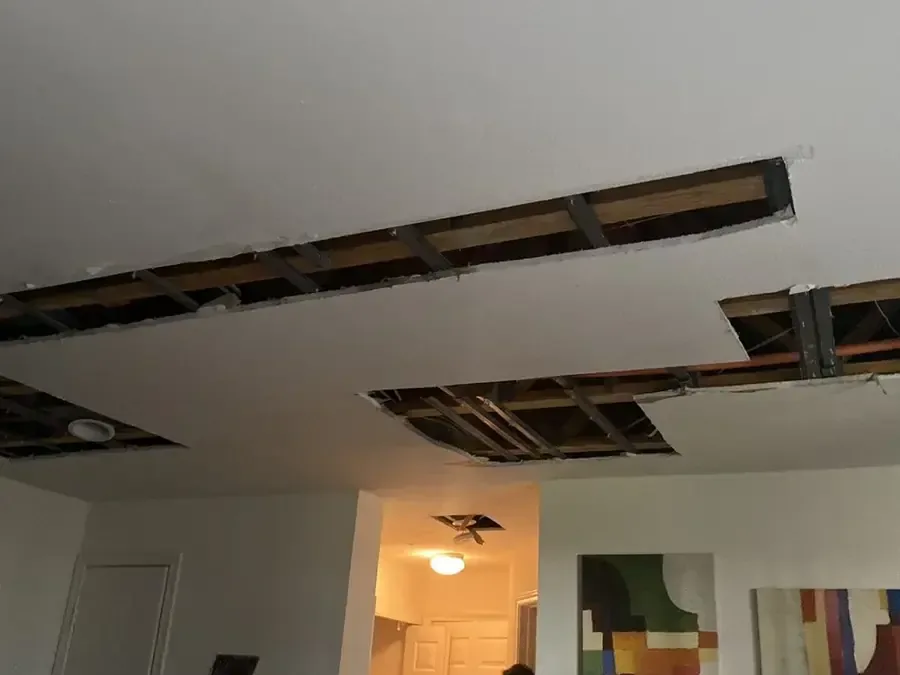
Hampden Hills has one of the largest groups of apartment complexes in the metro, and in a building like that a leak rarely stays in one unit. When water drips through a ceiling, the source is often a floor above, and the response involves neighbors, a property manager and the people who dry the building.
Key takeaways
- Tell the property manager in writing as soon as water appears, and ask them to reach the unit above.
- A bulging ceiling can hold water and fall, so keep out from beneath it.
- Photograph the ceiling, walls and belongings before and after anything is moved.
- Wet ceilings, insulation and wall cavities need measured drying, not just a patch of paint.
- Keep a record of who was told and when, for the manager, the owner and any insurer.
Why leaks travel in apartment buildings
Hampden Hills is the newest developed part of Englewood, and its many apartment complexes put units on top of one another. Water that leaks from a supply pipe, a drain or an appliance above can run along framing and appear in a ceiling below.
That means the wet spot is often not near the source. A stain in a living room may come from a bathroom, a kitchen or a washer in the unit above, or from a pipe running between floors.
- Brown or yellow stains spreading across a ceiling
- Paint bubbling or peeling
- A ceiling that sags or bulges
- Dripping from a light fixture or vent
- Damp walls under the stained area
What to do first
Safety first. If water is dripping near a light fixture or outlet, switch off the circuit from a dry spot and stay clear.
A ceiling that bulges can drop a load of water and drywall, so people and pets should stay out of that room.
Then protect belongings. Move electronics and furniture away from the drip, and put plastic sheeting or buckets in place.
Cleanup after a leak from above also has to deal with the unit itself. The resident should avoid moving into the wet room until the crew confirms the electrical and structural risks, and any damaged items should be kept for the adjuster to see.
Notify the right people
The property manager needs to know right away, and the report should be written, with the time and a short description. The manager can reach the unit above and shut off the source if it is a building pipe.
If the water is from a neighbor's appliance or fixture, the building rules and the manager decide who is responsible for repair and cleanup.
- Tell the property manager in writing
- Ask them to check the unit above
- Ask for the water to be shut off if it is a building pipe
- Keep a copy of every message
Protect people and belongings
Photograph everything before it is moved. Take photos of the ceiling, the walls, the floor and each damaged item.
Move small items to a dry room, and cover furniture with plastic if it cannot be moved.
- Turn off power only from a dry spot
- Keep out from beneath a bulging ceiling
- Photograph before moving anything
- Move electronics and papers to a dry room
What the crew does
The crew uses a moisture meter and a thermal camera to find how far the water has traveled. In a multi-unit building, that often includes walls and the ceiling below the damaged area, not just the visible stain.
A ceiling that is sagging may be opened so trapped water can drain and the cavity can dry. Wet insulation is removed because it holds water against framing and drywall.
The ceiling leak water damage service page lists the steps, and the main service page for ceiling leak water damage adds more detail on pricing and process.
- Source and spread found with meter and camera
- Water-filled sections of ceiling released in a controlled way
- Wet insulation and soft drywall removed
- Walls and floors below checked for moisture
- Readings recorded for a written scope
Drying the building materials
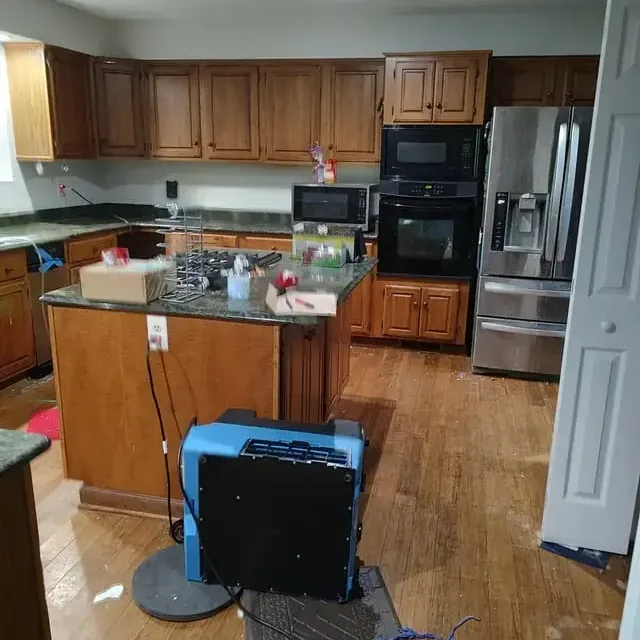
Drying equipment goes in once the wet materials are out. Air movers and dehumidifiers bring the remaining moisture down, and the crew takes readings each visit until framing and drywall match dry reference materials.
In an apartment building, drying also means thinking about shared walls and floors. The process is explained under structural drying, and the same principles apply in a single unit.
Shared walls, neighbors and noise
In a building with shared walls, drying equipment can affect neighbors. Air movers and dehumidifiers make noise and use power, and the crew explains the schedule so residents and the manager are not surprised.
If the water reached the unit below, that resident may need to be told as well. Water that moves through a floor can wet a ceiling in a third unit, so a manager often checks several apartments at once.
Good communication shortens the repair. When the manager, the resident and the crew all know the plan, the work moves in the right order: stop the source, remove the water, dry, then repair.
- Tell residents of nearby units about the drying equipment
- Ask the manager to check units below
- Keep a log of dates and who was told
- Ask about repair responsibility in writing
Responsibility, records and costs
Who pays depends on the cause, the lease and the building's insurance. A renter should ask the manager and check any renters coverage, and an owner should check the association rules and the policy.
Pricing printed on the service page for ceiling leak water damage is printed as ranges: one ceiling section $800 to $2,500, ceiling, walls and floor $2,500 to $5,500 and a long-running leak $5,500 to $11,000.
- Written report to the property manager
- Photos of the ceiling, walls and belongings
- List of damaged items with rough values
- Notes on when each person was told
- Contact for the insurer or the building's management
Questions
Who is responsible for a leak that comes from the unit above?
That depends on the cause, the lease or association rules and the insurance involved. The property manager is the first person to notify.
Should a sagging ceiling be popped to release the water?
Only with care. A bulging ceiling can fall, so people should stay out and the water should be released in a controlled way by trained crew.
Can a stain just be painted over?
Not until the area is dry. Painting over a wet ceiling traps moisture and the stain will come back.
Why are walls checked as well as the ceiling?
Water runs along framing and down wall cavities, so a wall can be wet even when the ceiling looks like the only damage.
What records help with a claim?
Photos, dates, a written report to the manager and a list of damaged items.