Structural Drying and Dehumidification in Thornton, CO
Surface dry is not dry. The drying team sizes air movers and LGR dehumidifiers to the class of loss, logs readings every day and leaves only when the framing, subfloor and slab of a Thornton home read dry.
(888) 532-8620Need it dried right? Call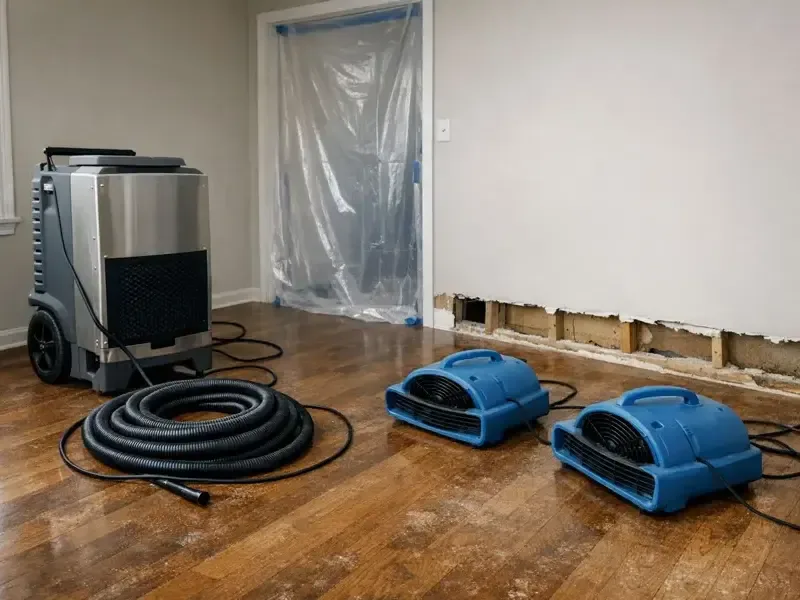
What a proper structural drying and dehumidification job takes in Thornton
Map before equipment
The tech who does the walkthrough reads every wet material and a dry reference first, so equipment in a Thornton home goes where the water actually is.
Size to the class
Air movers and dehumidifiers are set to the class of loss and the room volume, not to how many fans fit in the truck.
Readings every day
The drying team logs material readings and psychrometric data daily and moves equipment as wet areas dry.
Leave on the numbers
Equipment stays until materials read within 2 to 4 points of the dry reference, which is the IICRC S500 drying goal.
What to do right now about structural drying and dehumidification
- Leave the equipment running. Air movers and dehumidifiers work around the clock; turning them off at night adds days to the job.
- Keep doors and windows closed. A closed drying area lets the dehumidifiers control the air; open windows let humid summer air back in.
- Keep the heat steady. A normal room temperature speeds evaporation; do not shut the heat off in winter while drying runs.
- Do not reset the furniture. Leave furniture off the wet carpet and away from opened walls until the readings say the area is dry.
What does structural drying and dehumidification cost in Thornton, CO?
Structural drying usually runs $1,200 to $3,000 for one or two rooms, and $3,000 to $7,500 for a finished basement or several rooms. Large Class 3 or Class 4 losses that need desiccants and longer drying can run $7,500 to $20,000.
One or two rooms
- Class 1 or Class 2 loss
- Air movers and one dehumidifier
- Three to five days of readings
Basement or several rooms
- Class 2 or Class 3 loss
- Several dehumidifiers and air movers
- Daily psychrometric logs
Large or dense materials
- Class 4 hardwood, plaster or slab
- Desiccants and drying mats
- Extended drying and documentation
What moves the number most:
- The water category: clean, gray or black water
- Square footage and how many levels got wet
- Material class: carpet, drywall, hardwood or a concrete slab
- How many hours passed before drying started
Ranges are typical, not a quote. The water damage cost calculator gives a closer range for your own rooms.
Structural Drying and Dehumidification, step by step
On every Thornton job, moisture gets mapped before any equipment goes down, and the equipment stays until the readings say dry.
Moisture map and dry reference
The tech who does the walkthrough reads every wet material and a dry reference from the same material, and sets the class of loss.
Equipment to the load
Air movers go where evaporation is needed and LGR or desiccant dehumidifiers are sized to the room volume and the class.
Daily readings and moves
The drying team logs material readings and psychrometric data every day, moving equipment from dry areas to wet ones.
Verify and pull
Equipment leaves only when every material reads within 2 to 4 points of its dry reference, and the logs go into the claim file.
Structural drying is the part of a water job that decides whether the damage stops or keeps going. Water that soaked into framing, subfloor, drywall and concrete stays there after the surface looks dry, and it keeps feeding odor, swelling and the 24 to 48 hour mold window.
How a Thornton drying plan is built
The plan starts with a moisture map: every wet material, its reading and a dry reference reading from the same material in an unaffected area. The class of loss sets the equipment: Class 1 is a small, mostly surface loss, Class 2 a whole room with carpet and wall bottoms, Class 3 water from above with walls soaked high, and Class 4 dense materials such as hardwood, plaster and concrete.
- Air movers placed to the evaporation load
- LGR dehumidifiers sized to the room volume
- Desiccant dehumidifiers for Class 4 materials
- Drying mats for hardwood floors
Drying in a dry climate
Colorado air is usually dry, which helps evaporation, but it does not dry a basement slab or a wall cavity on its own. Concrete in a basement near Eastlake or Larkridge and the hardwood in a 1950s home off Washington Street both hold water deep and give it up slowly. Summer storm humidity slows the last points of drying, so dehumidifiers stay on until readings, not the calendar, say done.
- Air movers matched to the evaporation load
- Dehumidifiers matched to the room volume
- Readings checked against the dry reference every day
Walls or floors still wet days after a leak? Keep the doors closed and the heat steady, and call; the drying team maps it and sets the right equipment.
(888) 532-8620Get the moisture mapped tonightProof for the claim file
The drying team records temperature, relative humidity and grains per pound inside and outside the drying area every day, along with material readings. Those psychrometric logs show the adjuster the structure was dried to the goal. The EPA indoor air quality pages explain why damp materials should not stay in a home, and Colorado State University Extension publishes home care information for Colorado conditions.
Structural drying and dehumidification across the city and nearby Adams County
Dispatch runs day and night, and the restoration team works every neighborhood listed on the service area page.
Crews cover ZIP 80241 and the rest of the city, from the 1950s homes off Washington Street up past Larkridge and Thorncreek to the streets around Eastlake and East 160th Avenue.
Nearby coverage reaches Northglenn, Federal Heights, Westminster, Broomfield, Commerce City, Brighton and Todd Creek.
Related water damage services in Thornton
Structural Drying and Dehumidification questions, answered
Water still coming in?
Still damp after the cleanup? The drying team sets and monitors equipment around the clock.
(888) 532-8620 Talk drying with the teamWhat is structural drying, and why do Thornton homes need it?
Drying the building materials themselves, not just the surface: framing, subfloor, drywall, plaster and concrete. It uses moisture mapping, air movers and dehumidifiers, and it ends when readings match a dry reference.
How do crews know when the structure is dry?
They compare readings on wet materials with a dry reference reading from the same material in an unaffected area. The IICRC S500 goal is usually within 2 to 4 points of that reference.
Why not just open the windows?
Outside air is often dry in Colorado, but it is not controlled. Summer storm air is humid, and winter air chills wall cavities and slows drying. Closed rooms with dehumidifiers dry faster and more evenly.
What are psychrometric logs?
Daily records of temperature, relative humidity and grains per pound inside and outside the drying area, plus material readings. They show the drying progress and back up the claim file.
How long does structural drying take?
A Class 1 or 2 loss often dries in three to five days. Class 3 and Class 4 losses, such as soaked walls, hardwood or a basement slab, take longer. The drying time estimator shows a typical window.
Why is the equipment so loud and running all night?
Air movers and dehumidifiers work continuously to keep evaporation going. Turning them off overnight lets moisture settle back into materials and adds days to the job.
Is structural drying covered by insurance?
When the water loss itself is covered, drying is normally part of the mitigation. Coverage depends on your policy and the source, so check with your own insurer.
Need structural drying in Thornton? Dry it to the reading
Materials that look dry can still hold water deep inside. Dispatch runs 24/7 for moisture mapping.
(888) 532-8620Book the moisture mapping