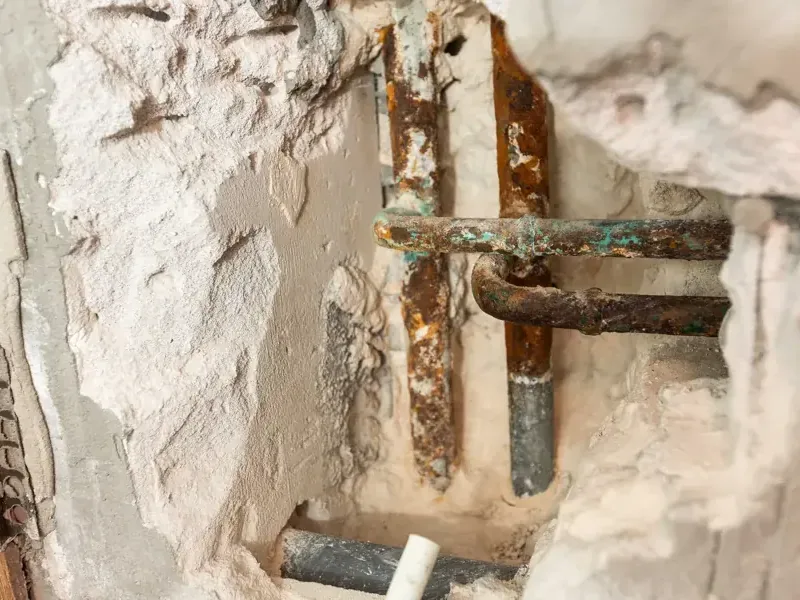
A split supply pipe can put water into a wall, a ceiling and a floor in a very short time. This post covers the order of actions after a break, from shutting the water off to the drying that follows behind the wall.
Key takeaways
- Find and close the main shutoff first, then open a faucet at the lowest point to drain the system.
- Power near wet walls and ceilings is a hazard; turn off the circuit only from a dry spot.
- Water inside a wall cavity keeps spreading after the visible puddle is gone, so extraction alone is not enough.
- Drying is measured with meters and a thermal camera, and wall openings are made on purpose to dry the cavity.
- Document the break, the water and the damage before repairs begin.
Why age matters when a pipe lets go
Thornton began as farmland until 1953 and grew into the first fully planned community in Adams County. By the end of 1955 the city had 5,500 residents in over 1,200 homes, and it incorporated soon after.
That means many homes here date from the 1950s onward, and decades of service can leave plumbing and fixtures well past new condition. Age alone does not mean a break is coming, but a split supply pipe in an older house often means more than one wet room, because water follows framing.
- Water stains on a ceiling below a bathroom
- A sudden drop in water pressure
- A hissing sound inside a wall
- Warped or stained baseboards
- A water meter that keeps moving with all fixtures off
The first actions, in order
The order matters because each step limits the next problem. Closing the water supply stops new water, and power safety protects people while the rest is sorted out.
Stop the water
Find the main shutoff valve and close it fully. Then open a faucet at the lowest point of the house to drain what is left in the pipes, which reduces how much more water can escape from the break.
If the valve will not close, the next step is to contact the water utility or a plumber right away.
- Close the main shutoff
- Open the lowest faucet to drain the pipes
- Leave the water heater alone until the system is checked
Protect people and belongings
Water in a ceiling or wall can reach light fixtures and outlets. Turn off the circuit for that area only from a dry spot, and keep out of rooms where water is dripping near wiring.
Move rugs, electronics and small furniture out of the wet area, and put foil or blocks under heavy furniture legs.
- Turn off power from a dry location only
- Move valuables to a dry room
- Photograph before moving anything
What the crew does first
The first job is extraction. Truck-mounted and portable units pull standing water from floors, and the crew checks ceilings below the break for water pooled above the drywall.
A moisture meter and a thermal camera show how far the water has gone. These readings are what justify opening a wall or ceiling section rather than guessing.
The service page for burst pipe water damage lists what is included, and the pulling of standing water is covered under water extraction.
- Standing water extracted from floors and low spots
- Ceilings checked for trapped water and cut open when needed
- Wet pad, insulation and soft drywall removed
- Readings logged for a written scope
Drying behind the wall
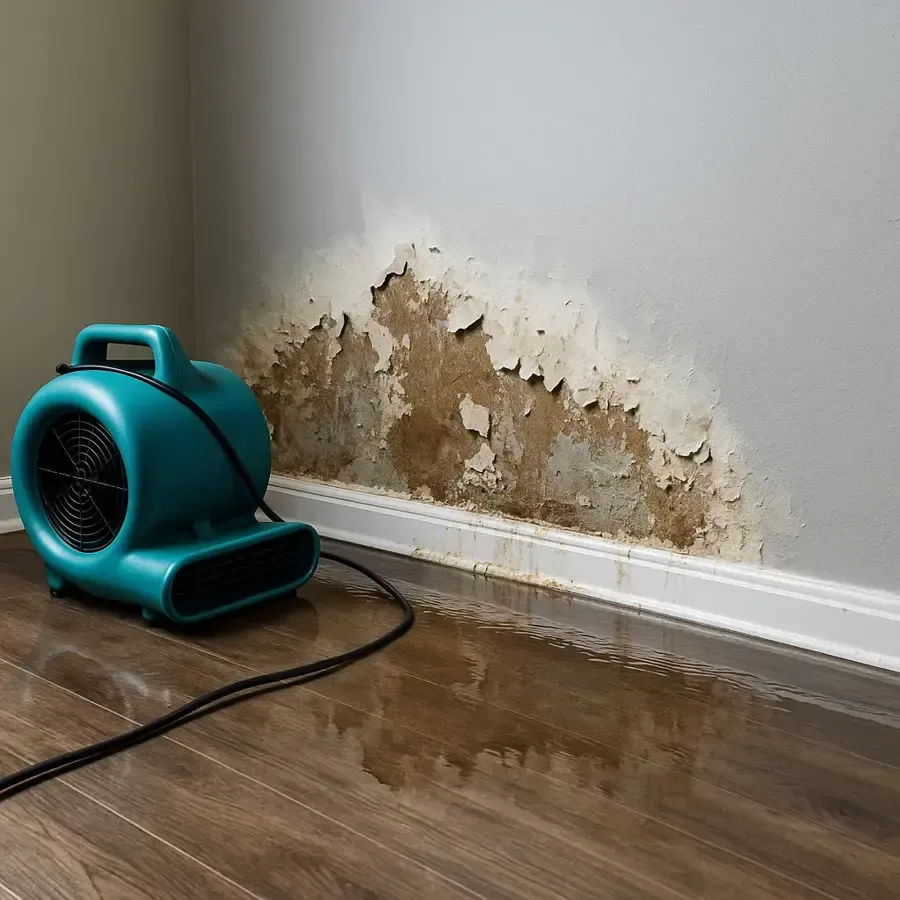
Water that has reached a wall cavity cannot be seen or reached from the surface. Small openings let air move through the cavity, and drying equipment runs until the framing and drywall read dry.
This is where structural drying matters. The process is described on the structural drying page and includes air movers, dehumidifiers and repeated readings.
Records for the plumber, the insurer and the repair
A burst pipe usually involves three parties: the plumber who repairs the break, the insurer who reviews the claim and the contractor who dries and rebuilds. A clean record helps all three.
The pricing printed on the service page for burst pipe water damage is printed as ranges: one room $1,200 to $3,000, two levels $3,000 to $7,500 and a whole-house loss $7,500 to $15,000. The final scope depends on what the readings show.
- Photos of the burst pipe before repair
- Date and time the water was found
- Written note of the shutoff time
- Photos of every wet room and damaged item
- Plumber's invoice and the damaged pipe section, if kept
Drying in place or opening the wall
Not every wet wall has to come apart. If readings show the drywall is only damp and the cavity is clear of standing water, small holes and airflow can be enough to dry it without removing the board.
If insulation is soaked, drywall is soft or the paint is bubbling, the section is removed. Wet insulation holds water against framing, so it is taken out and replaced after drying.
The decision rests on the readings, not on a rule of thumb. A technician compares the wet area with a known dry wall in the same home, and that comparison sets the target for the end of the job.
- Soft or crumbling drywall is removed
- Wet insulation is removed and replaced after drying
- Painted walls that read dry are usually left in place
- A dry wall in the same home sets the target reading
Mistakes that make a break worse
The most common mistake is stopping when the floor looks dry. Water inside the cavity keeps wetting drywall and insulation long after the puddle is gone.
Another is repairing the pipe and closing the wall before the cavity is dry, which traps moisture where it cannot be reached later.
- Waiting to shut off the water
- Running fans without removing wet insulation
- Closing walls before readings are dry
- Leaving wet pad in place under furniture
Questions
Where is the main shutoff in an older house?
It is often near the water meter, in a utility area or along an exterior wall. Finding it before an emergency saves time, and each person in the home should know where it is.
Is it safe to keep the power on after a burst pipe?
Not near wet walls or ceilings. Turn off the circuit from a dry spot, and have an electrician check the area if water reached outlets or fixtures.
Will the ceiling below the break need to come down?
Sometimes. If water is pooled above the drywall, it may be cut open so the water can drain and the cavity can dry.
How long does drying take?
It depends on the materials and how much water they hold. Drying runs until meter readings match dry reference materials, not for a set number of days.
Does a burst pipe always cause damage in several rooms?
No, but water often moves along framing, so rooms near the break and the level below should be checked even when they look fine.