Structural Drying and Dehumidification in Erie, CO
After any leak or flood, wet framing and subfloors need planned drying before repairs. The crew places air movers and dehumidifiers and reads the moisture until the structure is truly dry, not just dry to the touch.
(888) 532-8620Plan the structural dry-out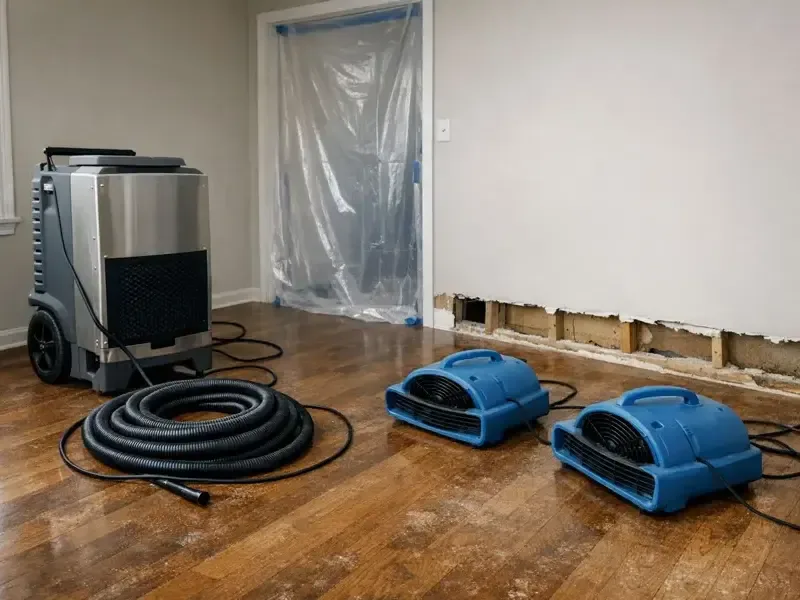
What a proper structural drying and dehumidification job takes in Erie
Dry to the touch is not dry
Surfaces can feel dry while the material behind them still holds moisture, and only a meter or imaging camera can see that.
Equipment works as a system
Air movers and dehumidifiers depend on each other, so placement, count and sizing decide how fast the room dries.
Dense materials set the pace
Hardwood, framing and concrete hold water longest, and they determine how many days the equipment must run.
Logs prove the result
Readings from every visit show the structure reached dry standards before anything was rebuilt on top of it.
What to do right now about structural drying and dehumidification
- Moisture survey. Meters and thermal imaging map the wet areas in floors, walls and ceilings before any machine is placed.
- Equipment placement. Air movers and dehumidifiers are set to match the size of the wet area and the density of the materials.
- Check and adjust. Readings are logged at each visit, and machines are moved or removed as areas reach dry.
- Release the structure. Equipment comes out only when readings match the dry reference areas, and the logs are handed over.
What does structural drying and dehumidification cost in Erie, CO?
One or two rooms of structural drying often cost $1,200 to $3,000. A basement or several rooms run $3,000 to $7,500, and large areas or dense materials can reach $7,500 to $20,000. Equipment time drives most of that.
One or two rooms
- Small wet area only
- A few machines in place
- Short equipment time
Basement or several rooms
- More rooms or a lower level
- Several machines running for days
- Frequent moisture readings
Large or dense materials
- Whole level or heavy loss
- Thick materials dry slowly
- Extended equipment time on site
What moves the number most:
- The water category: clean, gray or black water
- Square footage and how many levels got wet
- Material class: carpet, drywall, hardwood or a concrete slab
- How many hours passed before drying started
Ranges are typical, not a quote. The water damage cost calculator gives a closer range for your own rooms.
Structural Drying and Dehumidification, step by step
On every Erie job, moisture gets mapped before any equipment goes down, and the equipment stays until the readings say dry.
Call and scope
The crew asks about the source, the rooms involved and the materials that got wet, such as carpet, wood or concrete. Access to power and water for the equipment is noted.
Survey and plan
A technician maps the moisture and lays out an equipment plan, including how many machines each room needs.
Setup and monitoring
Machines run continuously while readings are logged at each visit and airflow is adjusted as areas dry. Equipment sits where airflow reaches wet cavities.
Verification and release
Dry standards are confirmed with final readings, equipment is removed and the records go to the homeowner.
Pumping out the water is only half the job. The rest is locked inside materials such as framing, subfloors, concrete and drywall, and it can only leave as vapor. Structural drying is the planned process that coaxes that moisture out safely, room by room.
How the drying process works
Warm, dry air does the work. Air movers keep a thin stream of air passing over wet surfaces so moisture lifts off them, and dehumidifiers collect that moisture from the room before it settles somewhere else. Doors and windows stay shut so outside humidity cannot undo the progress. At every visit the technician reads the meters again and shifts equipment toward whatever is still wet.
- Moisture mapped before any machine is placed
- Air movers aimed at wet surfaces
- Dehumidifiers matched to the room size
- Readings recorded at each visit
Materials dry at different rates
Drywall and carpet give up water fairly quickly, while hardwood, framing and concrete hold it much longer, and those dense materials set the pace for the whole job. Rather than guess, the crew compares readings with dry reference points in unaffected parts of the same home, so the target is real. Cavities may be opened at the base to let air reach insulation and the bottom plate.
- Drywall and pad dry fastest
- Wood and framing take longer
- Concrete releases moisture slowly
Wet framing that is left alone keeps releasing moisture into finishes. Call now, any hour, and describe the loss so the crew can set up controlled drying.
(888) 532-8620Ask about the dry-out planWhen drying is finished
Equipment leaves only when every material reads at or close to its dry reference, because a structure released early keeps feeding moisture into finishes and framing. The final log becomes part of the insurance file, and rebuilding then begins on a verified dry base. If one corner stays wet, the crew adjusts airflow there instead of extending the whole setup. For the first step of a wet-floor job, see water extraction.
Structural drying and dehumidification across Erie and the towns nearby
Dispatch runs day and night, and the restoration team works every neighborhood listed on the service area page.
Structural drying covers homes across Erie, including Old Town Erie, Anthem Highlands, Erie Highlands and Canyon Creek, within ZIP 80516 in Weld and Boulder counties, with the same crew handling any removal.
The same service nearby: structural drying and dehumidification in Thornton, Superior, Brighton.
Related water damage services in Erie
Structural Drying and Dehumidification questions, answered
Water still coming in?
Wet framing keeps releasing moisture until it is measured and dried. Describe the loss and a crew can plan the equipment.
(888) 532-8620 Share the wet room detailsHow long does structural drying take?
Often several days, and longer for dense materials or large losses. Meters decide when it ends, not a calendar, and the crew explains the likely range after the first readings.
Why are doors and windows kept closed?
Dehumidifiers work best in a closed space. Opening doors and windows lets in outside humidity and slows the dry-out, so the room stays sealed between visits.
Is the noise normal?
Yes. Air movers and dehumidifiers run continuously, and the noise usually ends when the dry standard is reached. Moving machines to another room can help during sleep.
Can materials be dried in place?
Often. Drywall, subfloors and framing can dry in place if the loss is caught early, which keeps rebuilding smaller and cheaper.
How does the crew know it is dry?
By comparing readings to dry reference areas in the same house. Equipment leaves when the numbers match, not when surfaces feel dry.
Does drying stop mold from forming?
Fast, complete drying removes the moisture that growth needs, which lowers the chance of it starting. Damp materials left in place raise it.
Who documents the readings?
The crew logs readings and photos at each visit, and the homeowner receives the records for the insurance file.
Can drying equipment run on a normal household circuit?
Machines draw power, so the crew checks outlets and circuits first. Extension cords and breakers are managed to avoid overloads while equipment runs for days.
Wet structure? Get a controlled dry-out started
Call now and share the source and the rooms. The crew will explain equipment, readings and when it comes out.
(888) 532-8620Book the drying plan